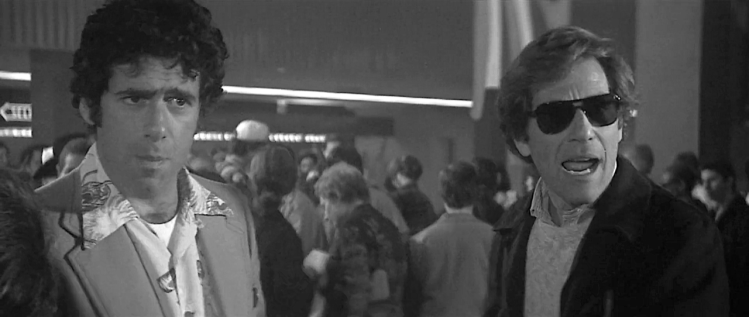
“By the time we got to California Split,” Elliott Gould once told me about his third collaboration with Robert Altman, “I knew exactly how to work with him. Then again, he didn’t even intend to cast me. It was going to be Steve McQueen first.”
For so celebrated a director, a surprising number of Altman’s movies remain relatively unknown: few recall Quintet, his bleak 1979 sci-fi, or Jazz ’34, his simple and brilliant musical companion to Kansas City – another that has quietly slunk off the radar screen itself. California Split’s obscurity is particularly perplexing, however, because it’s no side project or experimental excursion into unfamiliar territory. It’s a full on Robert Altman movie, in the freewheeling mould of a Nashville (indeed, his experiments here with using the new eight-track system to record overlapping dialogue led directly to the Nashville sound), starring the actor he’s perhaps most associated with.
Part of the reason it has gone under the radar is problems around music rights, which held up any home media release for decades. Little known as it is, though, it has become the Altman film with the most devoted cult: gamblers will tell you this hazy masterpiece is the greatest gambling movie ever made. No plot, all character, it’s a deceptively shaggy, jazzily penetrating study of the jumpy minds and empty, driven lives of compulsive gamblers, with Gould and George Segal as strangers who stick together because they bring each other luck, drifting LA’s casinos and racetracks, forever looking for the next bet.
Writer-producer, Joseph Walsh (who takes a small role as Segal’s creepy bookie), knew this shabby world well, and based the script on his own gambling addiction. He originally worked on it with Steven Spielberg; the pair almost made it with McQueen. It’s tempting to imagine the movie that might have been, but safe to say it wouldn’t have been so fully felt. Altman was a self-confessed recovering gambling addict and when, after considering Peter Falk and Robert De Niro, Walsh convinced him his long-term friend Gould was the perfect fit, the art-imitating-life line up was complete: Gould was another gambling obsessive. “Elliott lived his gambling,” Walsh has commented. “He was that character.”
Loose but wired, Gould decisively altered the movie. The ambiguous ending, as the central pair split, burned out in Reno, was the result of a line he improvised on-camera: “I gotta go home,” Segal mutters. “Yeah?” Gould spits back. “Where do you live?” Walsh had written an entire scene after this, but after seeing what Gould came up with, Altman never bothered to film it.
“What I get from Altman’s work is that he shows a life taking its course,” Gould told me. “He gave me the opportunity to experience as well as to exhibit – and I was able to give him perhaps more than he bargained for. And we worked great together, didn’t we?”
 Damien Love