For most of his career, the great cinema essayist Chris Marker’s work had a way of disappearing. Even if you couldn’t get his films out of your head, for many years they were so hard to see that you almost started to doubt that they had ever existed anywhere else. It almost felt intentional; film, memory, and the relationship between the two were some of his abiding concerns.
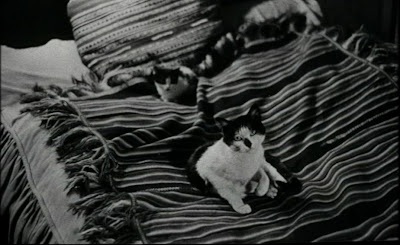
An elusive Frenchman, he was born sometime in the 1920s, perhaps in Outer Mongolia – he said this here and there from time to time, but might have been making it up. Marker covered his tracks, hated interviews and, despite or because of his fascination with the photographic image, avoided being photographed. He loved cats.
Before films he had fought with the Resistance, travelled the globe as a journalist, published a novel and wrote poetry. In a way, he never really abandoned any of these occupations. His films were literary, resisted dominant concepts of cinema and were made around the world, beamed back like reports, precise, yet impressionistic, resoundingly poetic.
Of the thirty-odd films he completed since 1952, almost all were sort-of documentaries. Although, just to keep things implausible, one of his later pieces was the video for “Getting Away With It,” the debut 1989 single by Electronic, the unlikely supergroup formed by Joy Division/ New Order’s Bernard Sumner and former-Smith Johnny Marr.
La Jetée (1962), a 28-minute sci-fi about a soldier sent back in time from a post-apocalyptic future, was Marker’s only piece of filmed fiction, and remains his best-known work. Terry Gilliam remade it for no good reason as 12 Monkeys. It still seems like a perverse gag: a movie made (almost) entirely of still images. Yet it is overwhelmingly cinematic. And when – for a blink – the picture does move, it hits you like a revelation. (Marker sometimes claimed he made the film the way he did because he couldn’t afford a movie camera. Another entirely doubtful claim.)
San Soleil (1982) is probably his best-known documentary, and might be his masterpiece. A 100-minute collage, it unfolds as fragments of pensive verité footage captured by a cameraman who wanders the globe, always drawn back to Japan and the African continent. Over the imagery comes a meditative commentary from the woman to whom he writes, musing on what he sees, what he’s seen before. It’s impossible to sum up. It’s obsessive, serious, nostalgic without being sentimental, and it can be pretty funny. There are people and cats and robots, there is a fragment of absolute, unspeakable horror, and, as in La Jetée, there is Hitchcock’s Vertigo.
It feels like it has everything in it. Everything that matters, anyway. He died in 2012, they say.
 Damien Love